
A board meeting agenda is often the difference between a session that drives decisions and one that wastes everyone’s time. When the agenda is unclear or poorly structured, discussions drift, important topics get rushed, and meetings end without clear outcomes.
This issue is more common than many organizations expect. According to research from McKinsey, 61% of executives say that at least half of the time they spend making decisions, much of it during meetings, is ineffective. Without a clear structure and defined priorities, meetings easily turn into routine conversations rather than focused decision-making sessions.
For board management, the stakes are even higher. Directors meet less frequently than management teams, so every meeting must be carefully timed and focused on governance priorities. That’s why a clear agenda for board meeting discussions is essential.
This guide provides a step-by-step explanation of how to create a board meeting agenda: what to include, how to structure it, and what a ready-to-use template looks like.
Key takeaways
- A board meeting agenda is a governance tool that helps structure discussions, review reports, and guide board decisions.
- A clear agenda keeps meetings focused by prioritizing strategic topics, assigning responsibilities, and allocating time for each discussion.
- Creating an effective agenda involves reviewing previous meeting outcomes, gathering input from board members, and organizing topics in a logical order.
- Using a consistent board agenda template helps boards prepare meetings more quickly and maintain a clear, repeatable structure.
- Sharing the agenda and materials several days in advance allows directors to prepare and contribute to more productive discussions.
Why a strong board meeting agenda matters
There is a saying: “Meetings without an agenda are social events”. In the boardroom, every discussion needs to be purposeful and tied to serious responsibilities and decisions influencing the company’s future.
A well-crafted board agenda is a critical governance tool. It keeps board discussions focused and organized. It clarifies the meeting’s purpose, structures topics in a logical order, and ensures the most important issues receive attention, enabling the board to make informed decisions and stay aligned with strategic priorities.
See how the board agenda builder simplifies agenda creation and helps boards prepare meetings
What is a board meeting agenda?
A board meeting agenda is a structured document that outlines the topics to be discussed at a board meeting.
A board meeting agenda serves as a governance tool, helping directors review reports, discuss key issues, make decisions, and track action items. By organizing discussions in advance, the agenda keeps board meetings focused on the organization’s priorities.
Free board meeting agenda template
Effective board meetings require thoughtful planning, clear documentation, and seamless execution. A crucial part of this process is understanding how to make an agenda for a board meeting that drives productive discussions and decision-making.
The standardized template saves time and simplifies this process.
Not sure where to begin? Download our customizable agenda template (Word + Google Docs + PDF versions) to meet your company’s needs.

The core elements of a board meeting agenda
A comprehensive board meeting agenda provides the structure needed to guide discussions and ensures that time is spent effectively. While meeting agendas may vary depending on the organization and meeting goals, a typical structure often includes the following:
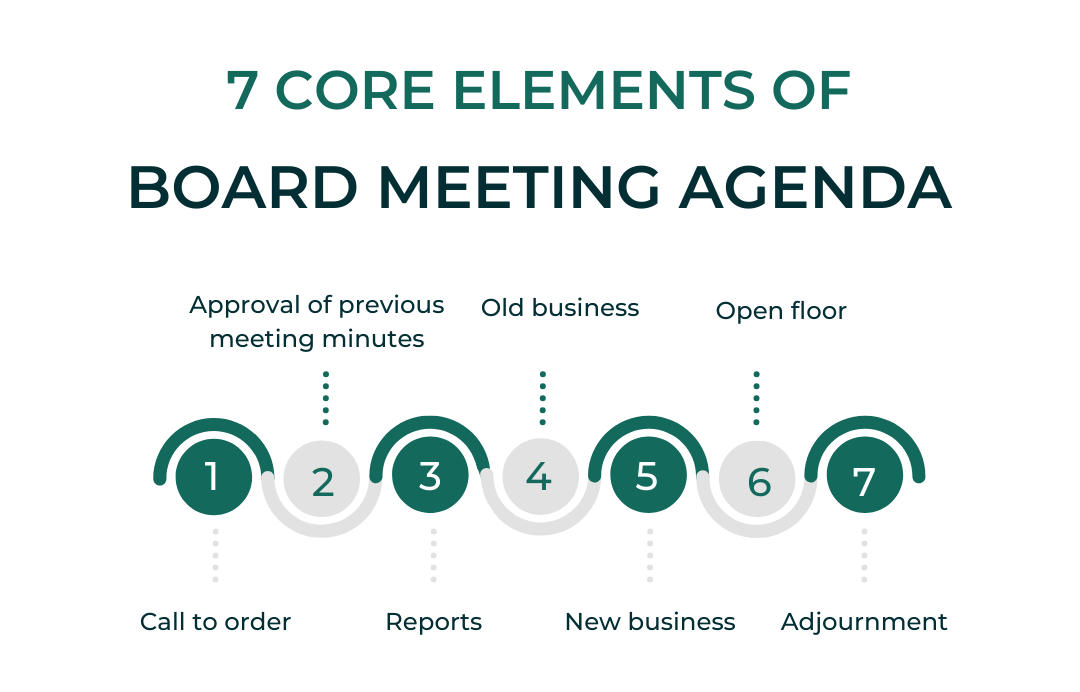
- Call to order. This marks the official start of the meeting and sets the tone. It’s an opportunity to confirm attendance, establish a quorum, and review the agenda.
- Approval of previous meeting minutes. Reviewing and approving the minutes from the last meeting ensures accountability and maintains a clear record of decisions and actions.
- Reports. These include updates on financial performance, operational activities, or committee work. Reports are usually informational but may also prompt discussion or decisions if issues arise.
- Old business. Items carried over from previous meetings are addressed here. This ensures unresolved matters are revisited and either resolved or scheduled for further follow-up.
- New business. New topics or issues requiring board attention are introduced here. These could range from strategic initiatives to emerging risks or opportunities.
- Open floor (optional). Some agendas include time for open discussion or unscheduled topics raised by board members. While useful, this should be carefully managed to avoid derailing the meeting’s focus.
- Adjournment. This step officially ends the meeting, often accompanied by a summary of key takeaways and next steps.
A comprehensive agenda balances operational and strategic priorities, helping the board address immediate needs while focusing on priorities.
Operational agenda items are essential for ensuring the organization’s day-to-day functions run smoothly. These updates provide a foundation for informed decision-making and often highlight issues that may require input.
Strategic agenda items, on the other hand, focus on high-level decision-making and long-term goals.
Here are some examples of operational versus strategic agenda items:
| Operational agenda items | Strategic agenda items |
|---|---|
| Financial reports and statement review | Strategic plan discussion |
| Compliance updates | Major investment decisions |
| Committee reports (e.g., audit, governance) | Market trend analysis |
| Performance metrics (e.g., turnover, efficiency) | New market or product launches |
| Routine contract approvals | Risk assessment (e.g., economic, cybersecurity) |
| Progress on ongoing projects | Succession planning |
| Strategic partnerships or acquisitions |
How to write agenda for a board meeting
Let’s look in more detail at the various steps in creating an agenda for a board meeting.
Define the role of the agenda owner
Every agenda needs a clear owner to ensure consistency from meeting to meeting. Whether it’s the сhair, the board secretary, or a designated facilitator, someone has to be responsible for drafting the agenda and ensuring it aligns with the board’s priorities.
The agenda owner gathers topics, structures them logically, and ensures that the agenda reflects the board’s priorities. Assign responsibility for each board agenda item during preparation, so presenters know in advance which updates or reports they must prepare.
Our article clarifies the roles of the board of directors and management
Review previous meeting outcomes
A well-designed agenda ties current discussions to previous decisions and next steps, creating a seamless thread of action and follow-up.
| Example: If the board asked a committee to evaluate a new investment or policy change, the board of directors meeting agenda should include time to review that committee’s findings and determine the next step. This creates a natural rhythm of decision-making, action, and evaluation. |
Starting the planning process with these questions helps maintain accountability:
- What decisions were made last time?
- What actions were assigned?
- Which topics remain unresolved?
Collect input from board members
An effective board meeting agenda rarely comes from a single person. Board chairs and secretaries usually gather suggestions from directors and senior leadership before finalizing the agenda.
This step ensures that the board does not overlook important governance topics and that the meeting reflects the board’s current priorities.
No matter how experienced or insightful an agenda planner might be, no single person can have complete visibility into every issue that matters to the board. That’s why creating a truly effective board meeting agenda thrives on collaboration.
For this, the meeting hosts use structured mechanisms to gather information, such as board meeting agenda software, or pre-meeting surveys.
Tip: Request suggested topics several days before finalizing the agenda and ask directors to explain the purpose of each topic (decision, update, or discussion).
Prioritize and structure agenda items
The Pareto Principle, often called the 80/20 rule, offers a practical perspective on prioritizing board meeting agendas. Simply put, 20% of the items on the agenda are likely to drive 80% of the meeting’s impact, so prioritize them accordingly.
Complex topics such as a major partnership, a risk review, or leadership changes should appear early in the overall meeting agenda to ensure adequate attention.
Meanwhile, routine updates typically don’t require the same depth of discussion. These can often be handled ahead of time through pre-meeting materials or bundled into the consent agenda for quick approval.
Allocate time for each item
Time-boxing (allocating specific time slots to agenda items) is one of the simplest ways to keep meetings productive. Assigning a clear time limit to each discussion helps prevent a single topic from consuming the entire meeting.
However, the agenda should still allow some flexibility for deeper conversations when needed.
The following is an example of time-boxing for a board meeting.
| Agenda section | Typical purpose | Recommended duration |
|---|---|---|
| Call to order and agenda approval | Opening remarks and agenda approval | 5 minutes |
| Approval of previous minutes | Confirm the accuracy of past records | 5–10 minutes |
| Reports and updates | Financial reports, leadership updates, committee reports | 20–30 minutes |
| Strategic discussion items | Key decisions or major topics requiring board input | 30–45 minutes |
| Committee reports | Updates from committees | 10–20 minutes |
| New business | Emerging topics or proposals | 15–20 minutes |
| Executive session | Private discussion among board members | 10–15 minutes |
| Summary and next meeting date | Confirm action items and schedule the next meeting | 5 minutes |
Send the agenda early
Sending the agenda early provides board members time to review materials and prepare questions before the meeting. Most boards share the agenda ahead of the meeting, ideally five to seven days in advance.
This approach helps directors focus on decisions rather than spend time reviewing background information during the meeting.
Tip: Include key documents, summaries from the executive director, and a virtual meeting link (if applicable) together with the agenda to simplify preparation.
Board meeting agenda format: What to include
A clear format of agenda of board meeting helps directors quickly understand what will be discussed, who is responsible for each topic, and the expected outcome from the discussion. Instead of being just a simple schedule, a structured agenda supports board meeting preparation and keeps discussions organized throughout the meeting.
While organizations may adapt the format to their governance style, most agendas include a few standard elements.
- Header block. The top of the agenda typically contains basic meeting information so directors can immediately identify the session. This usually includes the organization name, meeting date, time, and location. If the meeting is held online, the header should also include the virtual meeting details.
- Agenda item numbering. Each topic is listed in a numbered order so participants can easily follow the meeting’s flow. Numbering also helps when referencing topics during discussions or in meeting minutes.
- Time allocations. Assigning a time slot to each item keeps the meeting focused and prevents discussions from running longer than planned. For example, routine updates may require only a few minutes, while strategic discussions require longer time blocks.
- Presenter or owner. Most agendas include the name of the person responsible for presenting or leading each topic. This might be a board member, the CEO, the executive director, or a committee chair. Listing presenters ensures that everyone knows their role before the meeting begins.
- Action or outcome column. Many boards include a column that explains the purpose of each discussion. For example, the board may need to approve a decision, review a report, or discuss a proposal. Identifying the expected outcome helps directors focus on what the board needs to accomplish during the meeting.
Board meeting agenda examples
Below are several real-world examples of board meeting agendas from different types of organizations. Reviewing them can help you understand how boards structure discussions, organize decisions, and plan meeting flow in practice.
- Corporate board meeting agenda example (Highlands Ranch Water and Sanitation District). This corporate-style example includes items such as a call to order, approval of minutes, presentations, consent items, and formal resolutions for approval.
- Nonprofit board meeting agenda example (Wyoming Association of Irrigation Districts). A nonprofit board’s agenda typically includes sections such as announcements, approval of previous minutes, treasurer’s report, committee updates, old business, and new business.
- Small business board meeting agenda example (Public School Academy). This agenda example for a small organization includes a call to order, approval of the agenda, approval of prior minutes, discussion topics, and adjournment.
- Annual board meeting agenda example (Orange County Continuum of Care). Formal board meetings with public participation will benefit from this agenda example. It includes consent calendar items, funding discussions, program updates, and scheduling of the next meeting.
Who sets the board meeting agenda?
The board chair is usually responsible for deciding what appears on the board meeting agenda. The chair ensures that the meeting focuses on the organization’s priorities and that the board spends time on the most important decisions and governance topics.
However, the chair rarely prepares the agenda alone.
In most organizations, the corporate secretary or governance officer drafts the agenda and organizes the materials, while committee chairs and senior executives suggest topics that require board attention.
The exact process varies by organization type. For example, nonprofit boards often involve the executive director in agenda planning, while corporate boards typically rely on coordination between the chair and the corporate secretary.
Board meeting agenda sample
Here’s a sample board meeting agenda for a quarterly board meeting of a mid-sized SaaS company. This example shows how a fully populated agenda may look, including real discussion topics, presenters, and expected outcomes.
- Organization: Orion Analytics Inc.
- Meeting type: Q3 board of directors meeting
- Date: September 18, 2026
- Time: 10:00 AM–12:00 PM
- Location: Orion HQ Boardroom, New York
| Time | Agenda item | Presenter | Purpose/outcome |
|---|---|---|---|
| 10:00–10:05 | Call to order and approval of agenda | Board chair | Approve the agenda for the meeting |
| 10:05–10:10 | Approval of June 2026 board minutes | Corporate secretary | Confirm the accuracy of the prior meeting record |
| 10:10–10:25 | CEO strategic update | CEO | Review company performance, market developments, and strategic priorities |
| 10:25–10:40 | Q3 financial results and outlook | CFO | Review revenue growth, operating costs, and updated forecast |
| 10:40–11:00 | Proposed acquisition of DataFlow Labs | CEO & CFO | Board discussion and approval decision |
| 11:00–11:10 | Cybersecurity risk review | Audit committee chair | Review recent audit findings and risk mitigation actions |
| 11:10–11:20 | Product roadmap update | CTO | Present upcoming product releases and R&D priorities |
| 11:20–11:30 | Compensation committee report | Compensation committee chair | Approve executive bonus structure for FY2026 |
| 11:30–11:40 | New business | Board chair | Discuss expansion into the European market |
| 11:40–11:50 | Executive session (board only) | Board members | Private board discussion without management |
| 11:50–11:55 | Action items and decisions recap | Corporate secretary | Confirm approved decisions and assigned responsibilities |
| 11:55–12:00 | Adjournment | Board chair | Close the meeting |
Common challenges and solutions
Let’s take a closer look at some common challenges when drafting the agenda of a board meeting and solutions to overcome them.
Packed agendas, minimal progress
One of the typical pitfalls is attempting to address too many items in a single meeting, resulting in rushed discussions and unresolved issues.
Solution: Consider using consent agendas to group routine items and pass in a single motion so boards can allocate their time more effectively. Also, assign realistic time slots to each item and leave a small buffer for overruns. If an item isn’t critical, consider moving it to a follow-up meeting or handling it offline.
Strategic topics left behind
Sometimes operational discussions monopolize meetings, leaving little time for strategic matters. This challenge is especially relevant when crafting a draft agenda for the first board meeting, where setting the tone and addressing foundational goals is crucial. However, this imbalance can affect long-term planning and growth.
Solution: Schedule the most pressing discussions early in the meeting when everyone is focused. Be clear about what you want to achieve, be it a decision, brainstorming, or an update.
Passive participation and unprepared members
Disengaged or unprepared attendees can drag down the effectiveness of a meeting. Often, this stems from unclear expectations or last-minute access to materials
Solution: Share the agenda a few days before the meeting, and include any necessary pre-reading or data. Specify the purpose of each item—whether it’s for decision-making, input, or information-sharing. Assign roles such as a timekeeper or discussion leader.
Inability to adapt to emerging needs
Overly rigid agendas can fail to accommodate urgent or unforeseen issues arising during discussions.
Solution: Incorporate a degree of flexibility by reserving time for emerging issues or creating a “parking lot” to temporarily set aside non-urgent topics.
Board meeting agenda best practices
Here’s a quick dos-and-don’ts guide for creating a board meeting agenda for your reference.
| Do | Don’t |
|---|---|
| Distribute the agenda 5–7 days in advance. | Send it the night before the meeting. |
| Use a consent agenda for routine items. | Spend board time on items requiring no debate. |
| Assign a time slot to each item. | Leave time open-ended for every topic. |
| Include a clear purpose label per item (decision/update/discussion). | List items with no indication of what’s expected. |
| Prioritize strategic items at the start. | Fill the top of the agenda with operational reports. |
How board management software simplifies agenda creation
Preparing a board meeting agenda manually often involves multiple documents, emails, and revisions. As meetings become more complex, coordinating agenda items, materials, and participant input takes significant time. Board management software helps streamline this process by centralizing planning, documents, and communication in one place.
Let’s take a look at how the process of creating a board meeting agenda differs between manual and software-based approaches.
| Manual agenda preparation | Software-based agenda preparation |
|---|---|
| Agenda drafted in separate documents or spreadsheets | Agendas created in a structured system with built-in templates |
| Materials shared through email attachments | Documents attached directly to agenda items |
| Version control is handled manually | Automatic updates and centralized access |
| Directors search across multiple emails for materials | All materials are organized in one secure platform |
| Updates or changes sent individually | Participants are notified automatically when the agenda is updated |
Dedicated board management platforms such as Ideals Board simplify agenda preparation and help boards stay organized.
For example, the Ideals Board agenda builder allows teams to create structured agendas using preset items and templates, attach supporting documents, and assign time limits to each topic. During the meeting, integrated meeting minutes tools help capture notes directly under agenda items and export the finalized minutes in various formats, including PDF or Word.
Final thoughts
A well-structured board meeting agenda helps boards use their time effectively and keep discussions focused.
By defining clear agenda items, assigning time limits, and preparing materials in advance, organizations can run meetings that support accountability and strategic oversight.
Use a consistent agenda format and practical tools, such as templates or dedicated board management software, to simplify this process and maintain productive, well-organized meetings for your board.